
Do Better Norge is making one of the hardest arguments in contemporary Norway: that the state speaks fluently about children's interests while too often letting fathers, immigrant parents, and family continuity become negotiable. That is an advocacy argument, not a court holding. But it is not floating in thin air. The official European Court of Human Rights record shows repeated Article 8 trouble for Norway in family-life cases, and that record is now too large to dismiss as anecdote.
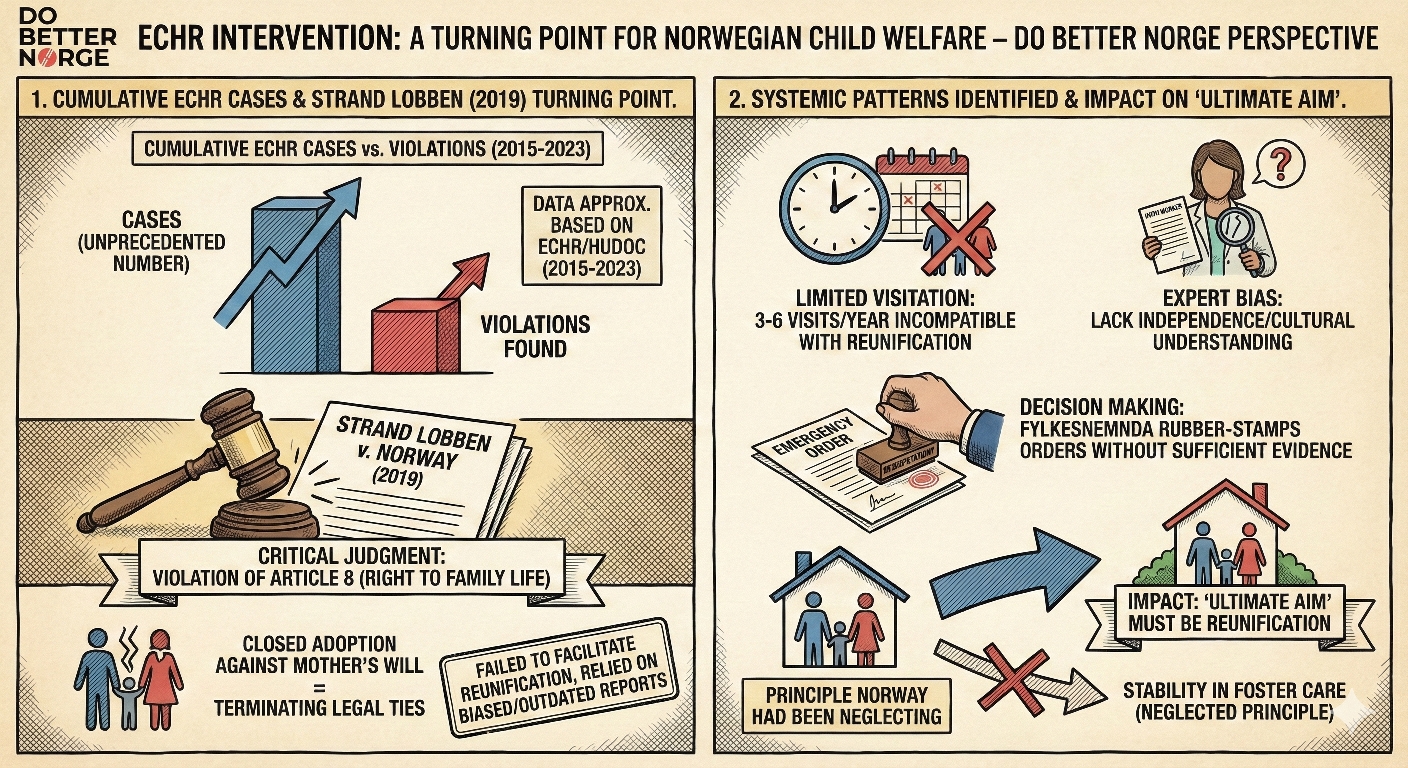
The cleanest official summary appears in the Court's own Norway country profile . It notes that on 14 September 2023 the Court dealt with 21 applications against Norway concerning children in public care , declaring 12 inadmissible and finding Article 8 violations in nine other similar applications. That does not prove every activist claim. It does prove there is a durable and visible Strasbourg problem.
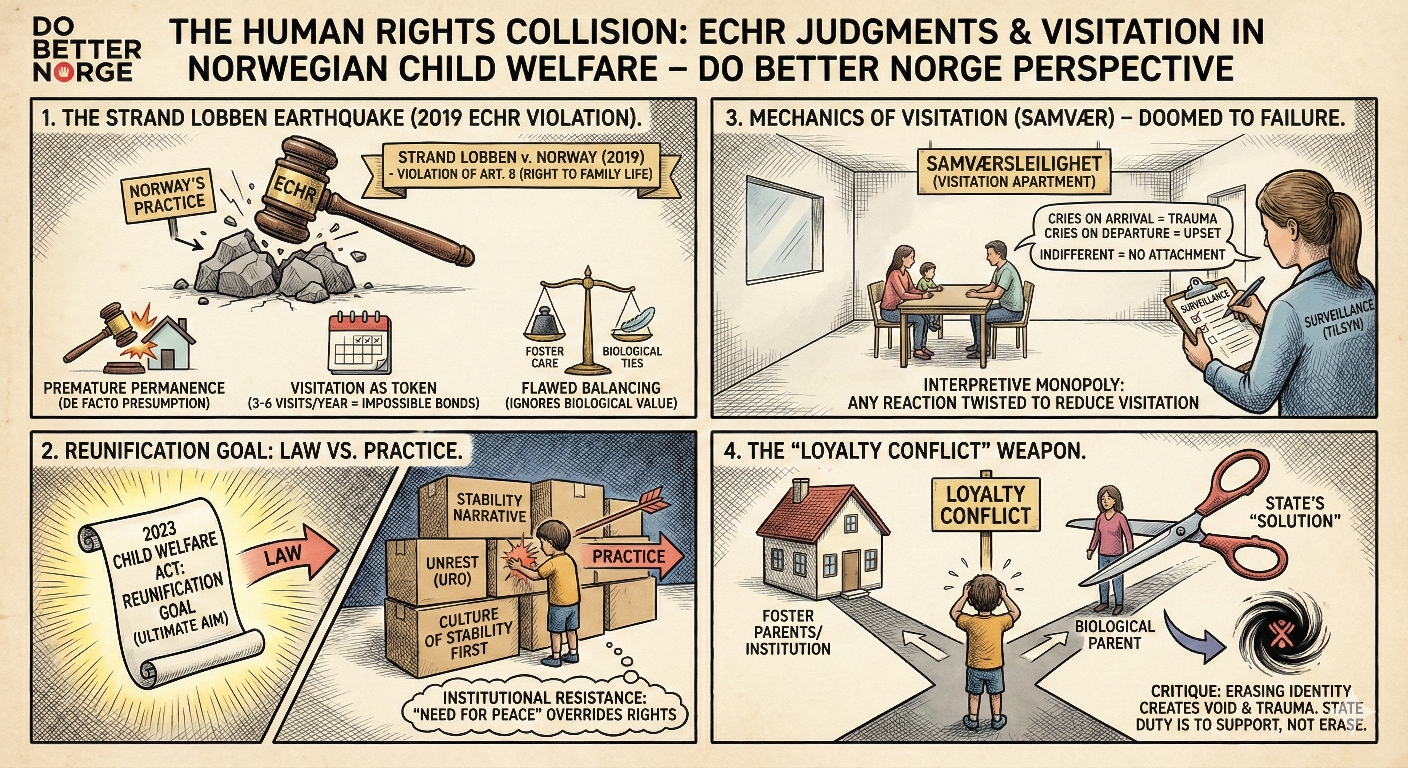
What keeps recurring in that problem is not always the original intervention by itself. The Court often focuses on what comes after: reduced contact, weak reunification work, long-term foster-care assumptions made too early, and a habit of letting time do the state's severing work. In Strand Lobben and Others v. Norway , the Grand Chamber made reunification doctrine impossible to ignore. In K.O. and V.M. v. Norway , the placement itself survived Article 8 scrutiny while the contact regime did not. That distinction matters enormously for fathers and non-resident parents: sometimes the legal fracture is not the first decision, but the slow starvation of the bond afterward.
That is why fathers' rights groups remain part of this conversation. The Court's country profile also includes father-access cases such as Sanchez Cardenas v. Norway and older Article 8 parental-rights litigation such as Johansen v. Norway . Advocacy groups like MannsForum and Foreningen 2 Foreldre are not citing the Court for decoration; they are intervening in a real problem-space where contact can collapse long before anyone admits that contact has been structurally undermined.
The immigrant-family dimension is equally difficult and equally real. The strongest single Strasbourg reference point remains Abdi Ibrahim v. Norway , where the Grand Chamber held that Norway had violated Article 8 in a case involving a Somali Muslim mother and the adoption of her child by a foster family. The significance of that judgment is not merely emotional. It says, in practical terms, that culture and religion are not decorative details to be mentioned late in the file. They are part of the child's family life and identity, and they must be given real weight.
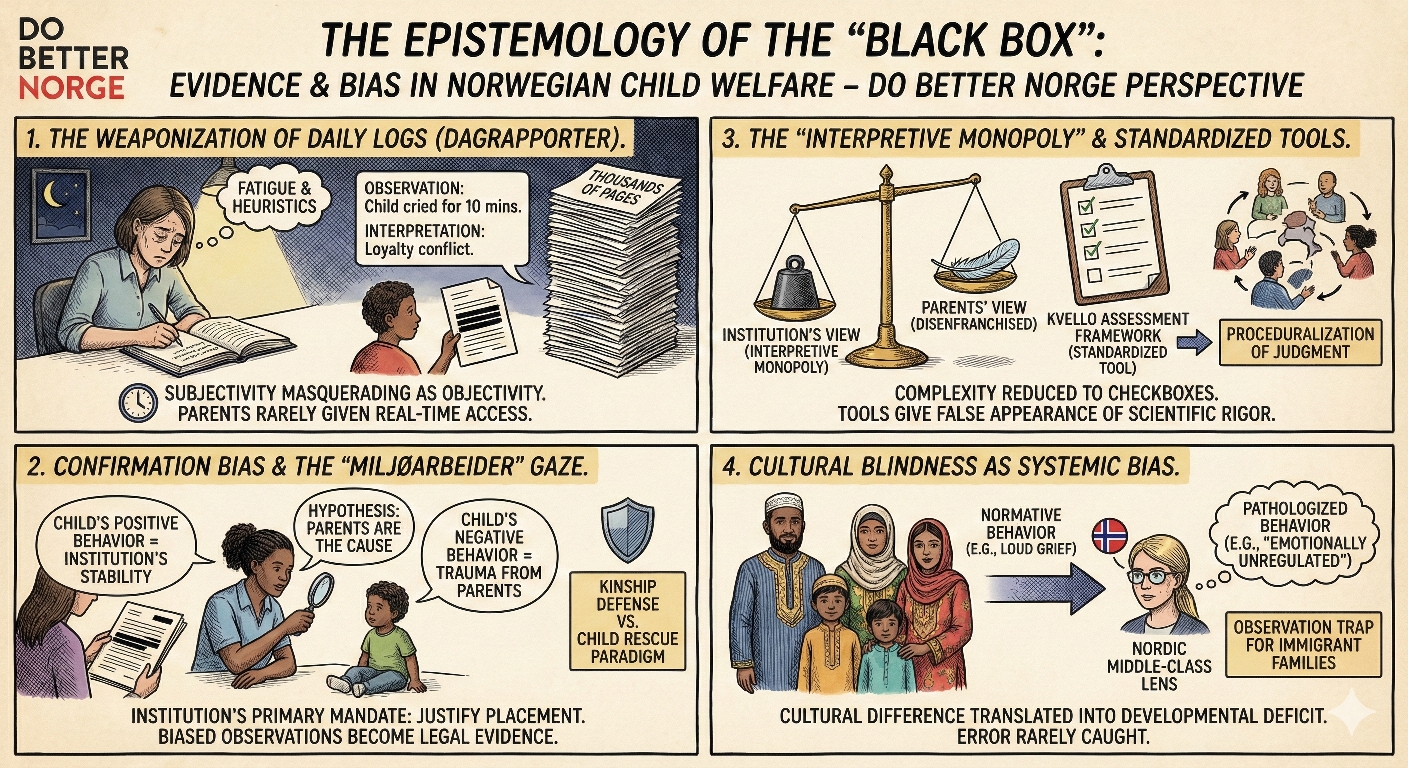
The Court's own Norway profile also reminds us that Article 8 trouble is not confined to child-welfare cases. Immigration-family-life cases such as Nunez v. Norway and Antwi and Others v. Norway show that the family-life question also reaches deportation and immigration enforcement. That matters here because one of the recurring claims from immigrant parents is that the system reads cultural difference as instability, or foreignness as reduced credibility. The Court does not endorse that sentence in those words, but the case law certainly keeps family life on the table when state power meets cross-border families.
This is where Do Better Norge becomes more than a protest banner. The project has built a visual and educational language around Article 8, samvar, oversight, cultural blindness, and the economic logic inside Norwegian child welfare. One can disagree with parts of its interpretation and still admit that it is doing something institutions often fail to do: making the structure legible for ordinary families. The same goes for rights groups working the fathers' side of the argument. Their claim is not that every mother wins unfairly, or that every public-care case is illegitimate. Their claim is that fathers and immigrant parents can enter systems where the presumption of distance arrives earlier than the presumption of repair.
The fairest way to put it is this. Norway does not have an imaginary problem. It has a documented Article 8 problem, an argument over how deep that problem runs, and a growing ecosystem of rights organizations trying to make sure the words family life keep meaning something when the file is thick, the expert culture is confident, and the parent in front of the state happens to be foreign, non-resident, or simply the father.